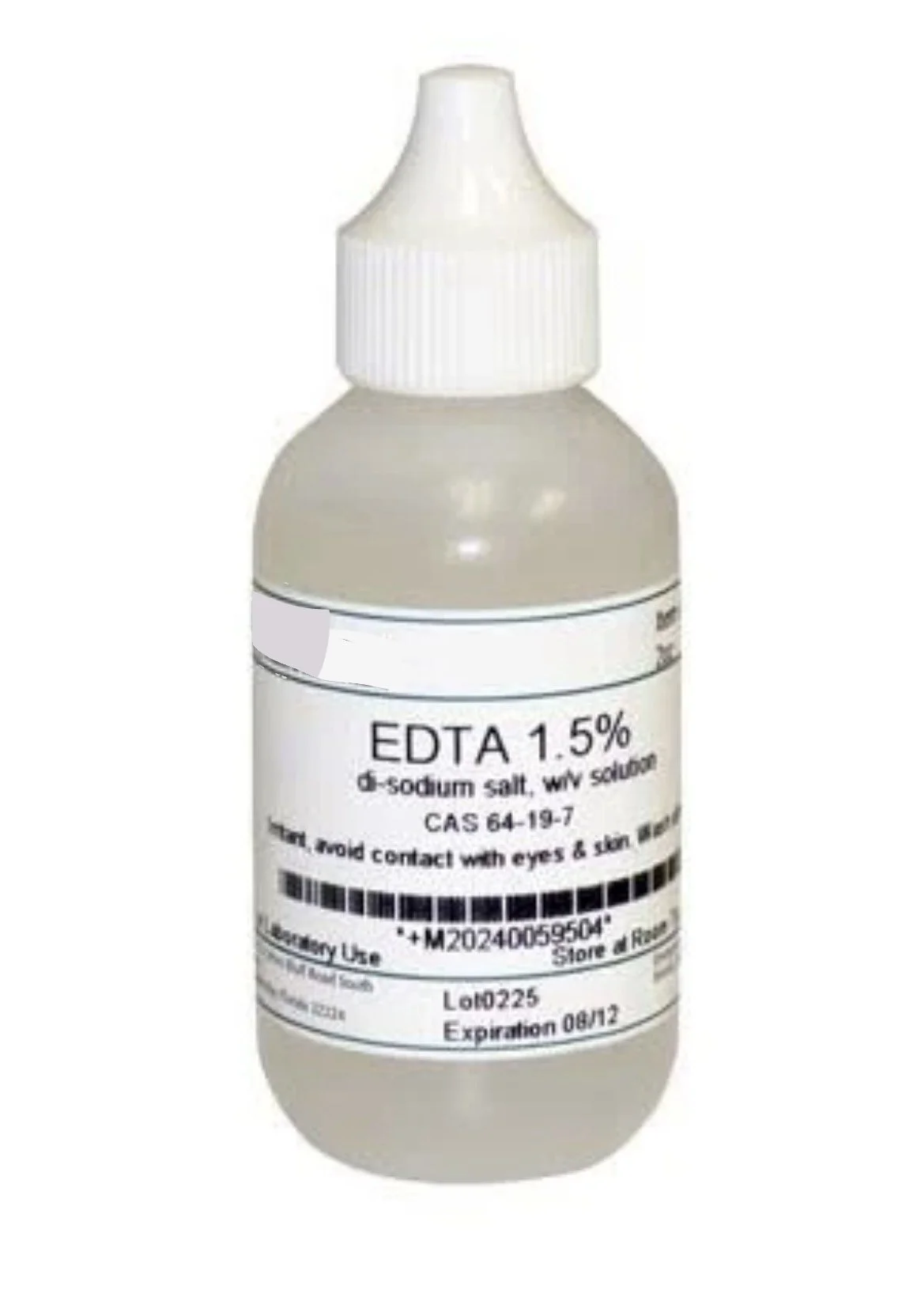
EDTA Disodium (Ethylenediaminetetraacetic Acid disodium salt) at 150 mg/mL (PF) refers to a parenteral (injectable) chelating agent formulated as a sterile, preservative-free solution for intravenous (IV) infusion. It’s a synthetic chelating molecule that binds divalent & trivalent metal ions in the bloodstream to form soluble complexes that are eliminated via the kidneys.
PF means Preservative-Free, appropriate for IV use.
EDTA binds to metal ions (calcium, lead, zinc, etc.) through multiple binding sites, allowing their removal from circulation.
Important: There are many laboratory/industrial EDTA solutions available (e.g., for dental/chemical uses), but these are not the same as IV/parenteral EDTA disodium intended for chelation therapy.
Benefits
Chelation therapy for heavy metal poisoning: EDTA has a long history as a chelating drug — most notably for lead poisoning. In this indication, IV EDTA binds lead in the bloodstream to form chelates that are excreted in urine, reducing overall body lead burden.
EDTA forms stable complexes with metal ions (especially lead and calcium), facilitating their urinary excretion.
EDTA Disodium (Ethylenediaminetetraacetic Acid disodium salt) at 150 mg/mL (PF) refers to a parenteral (injectable) chelating agent formulated as a sterile, preservative-free solution for intravenous (IV) infusion. It’s a synthetic chelating molecule that binds divalent & trivalent metal ions in the bloodstream to form soluble complexes that are eliminated via the kidneys.
PF means Preservative-Free, appropriate for IV use.
EDTA binds to metal ions (calcium, lead, zinc, etc.) through multiple binding sites, allowing their removal from circulation.
Important: There are many laboratory/industrial EDTA solutions available (e.g., for dental/chemical uses), but these are not the same as IV/parenteral EDTA disodium intended for chelation therapy.
Benefits
Chelation therapy for heavy metal poisoning: EDTA has a long history as a chelating drug — most notably for lead poisoning. In this indication, IV EDTA binds lead in the bloodstream to form chelates that are excreted in urine, reducing overall body lead burden.
EDTA forms stable complexes with metal ions (especially lead and calcium), facilitating their urinary excretion.