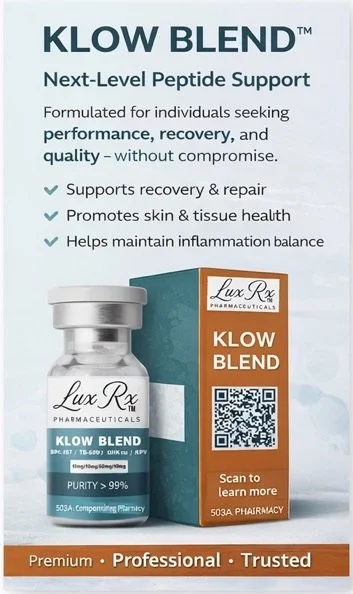
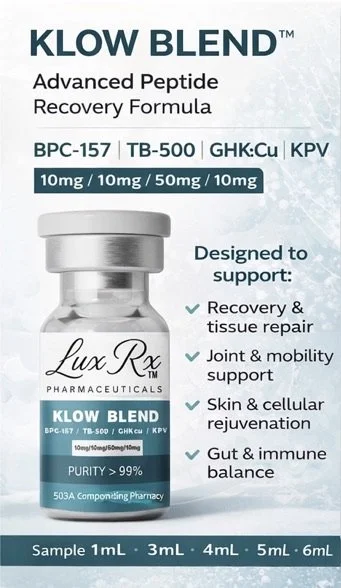
KLOW BLEND™ is a premium peptide formulation designed to support advanced recovery, tissue repair, and overall cellular health. This powerful blend combines BPC-157, TB-500, GHK-Cu, and KPV to promote mobility, skin rejuvenation, inflammation balance, and gut support. Compounded in a 503A pharmacy and held to 99%+ purity standards, KLOW BLEND™ delivers professional-grade quality you can trust.
Available Sizes:
Sample 1mL • 3mL • 4mL • 5mL • 6mL
BENEFITS
✔ Supports tissue repair & recovery
✔ Helps improve joint mobility & flexibility
✔ Promotes skin, hair & cellular rejuvenation
✔ Supports gut & immune balance
✔ Helps maintain healthy inflammation response
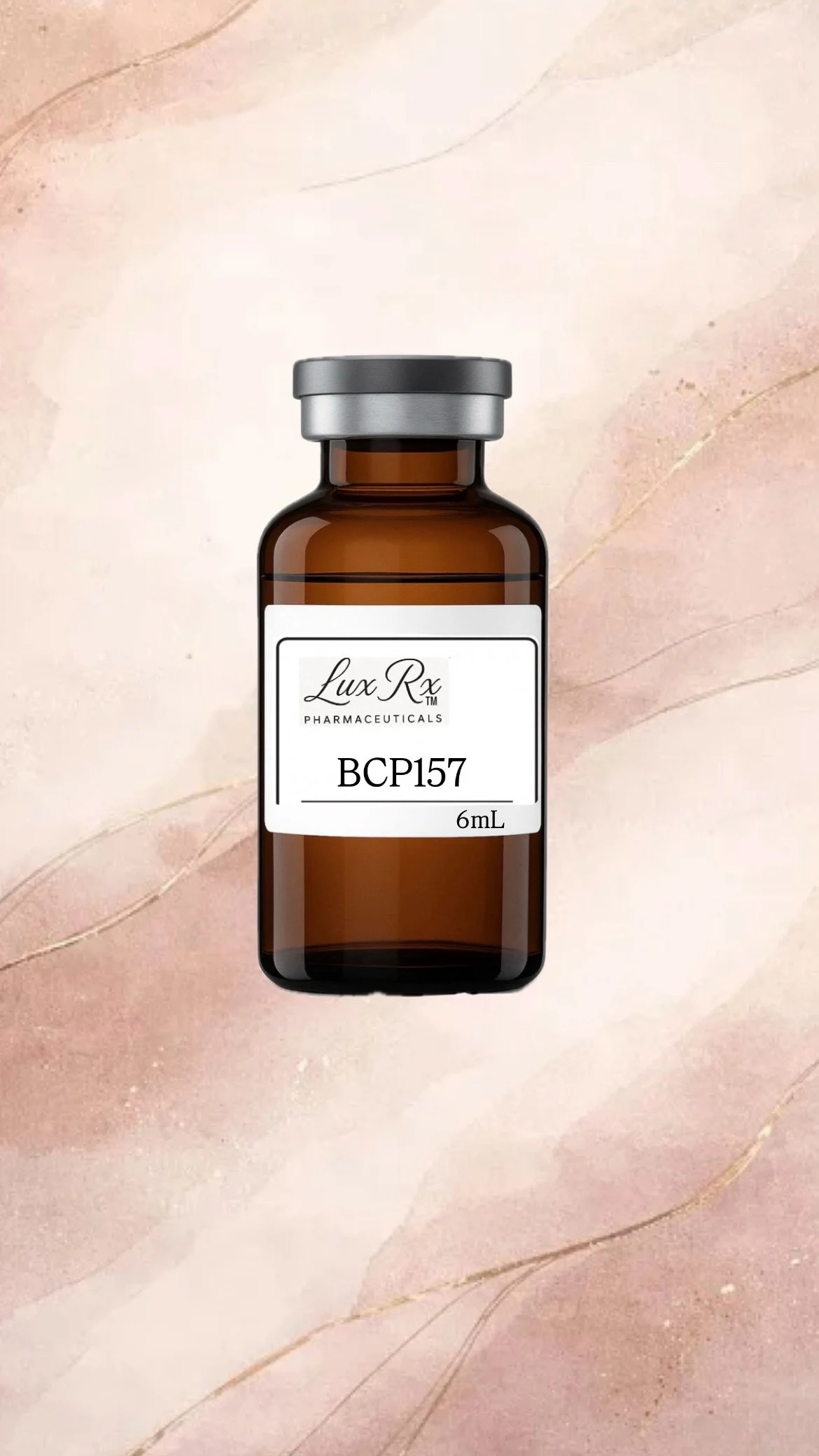
BPC-157 5 mL
BPC-157 (Body Protection Compound-157) is a synthetic peptide derived from a naturally occurring protein found in gastric juice. It is widely used in regenerative and wellness settings for its potential role in tissue repair, recovery, and overall cellular support.
BPC-157 is commonly included in wellness protocols focused on injury recovery, joint support, gut health, and inflammation management. The 5 mL vial format allows for provider-directed customization as part of a personalized treatment plan.
Benefits
• Supports tissue repair and recovery
• May help promote joint, tendon, and ligament health
• Often used to support gut lining and digestive health
• May assist with inflammation modulation
• Popular in recovery, wellness, and performance-focused protocols
Who It’s For?
BPC-157 may be considered for individuals seeking support with:
• Physical recovery or active lifestyles
• Joint or soft-tissue discomfort
• Digestive or gut health concerns
• Overall cellular and regenerative wellness
Use only under the supervision of a qualified healthcare provider.
This product is a prescription or provider-directed peptide. It is not FDA-approved for disease treatment. Intended for use as part of a medically supervised wellness program. Individual results may vary.
AOD-9604 + MOTS-C Peptide Therapy
AOD-9604 + MOTS-C is a powerful metabolic peptide combination designed to support fat loss, boost energy, and enhance overall body performance at a cellular level. This advanced duo works synergistically to help improve metabolism, increase fat breakdown, and promote a leaner, more toned appearance.
Benefits may include:
✨ Enhanced fat burning & metabolic support
✨ Increased energy & stamina
✨ Improved insulin sensitivity & glucose metabolism
✨ Supports muscle recovery & endurance
✨ Helps promote a leaner body composition
✨ Cellular rejuvenation & anti-aging support
Perfect for individuals looking to elevate their weight loss journey, improve physical performance, and optimize overall wellness.
AOD-9604 1.2 mg | MOTS-C 2 mg | Tesamorelin 3 mg
Advanced Metabolic & Body Composition Support
This peptide combination is designed to support fat metabolism, energy efficiency, and body composition through multiple metabolic pathways.
✨ AOD-9604
• Supports fat metabolism
• Studied for targeting stubborn fat
• Designed to mimic specific fat-burning actions of hGH without affecting IGF-1
⚡ MOTS-C
• Supports cellular energy and metabolic flexibility
• May help improve insulin sensitivity
• Linked to mitochondrial health and endurance support
🔥 Tesamorelin
• Stimulates natural growth hormone release
• Supports reduction of visceral fat
• May aid in lean muscle preservation and metabolic balance
Best results are typically seen when combined with proper nutrition, movement, and lifestyle optimization.
For educational purposes only. Individual results may vary.
AOD-9604 | Research Peptide Overview
AOD-9604 was developed to study the fat-burning properties associated with human growth hormone (hGH)—without impacting blood sugar or IGF-1 levels.
🔬 Research highlights:
• Designed to support fat metabolism
• Studied for potential benefits in body composition
• Early preclinical (animal) studies showed promising effects on fat reduction and bone health
📊 Clinical insight:
Although initial research was encouraging, later human trials did not demonstrate consistent weight-loss outcomes, and further pharmaceutical development was discontinued in 2007.
Today, AOD-9604 remains of interest in research and educational settings focused on metabolic and body composition science.
For educational and research purposes only.

CJC 1295(w/o DAC)5mg+IPA 5mg
Support improved muscle recovery, fat metabolism, sleep quality, energy, and youthful skin tone.
Increases lean muscle and reduces body fat
Enhances cellular repair and recovery
Improves sleep and overall vitality
Promotes collagen production and skin rejuvenation
Supports healthy metabolism and anti-aging processes
Recommended Use:
Reconstitute with bacteriostatic water before use. Typical dosing:
100–300mcg subcutaneously 1–3 times daily (per protocol guidance).
For professional use under medical supervision.
All injectable medications and peptides are sourced from licensed 503A or 503B compounding pharmacies and are dispensed pursuant to a valid prescription from a licensed medical provider. These compounded products are not FDA-approved as finished drugs. Individual results may vary. These therapies are not intended to diagnose, treat, cure, or prevent any disease and should be used only under medical supervision.

Amino Blend is a mix of essential and conditionally essential amino acids — such as;
L-Arginine,
L-Citrulline,
L-Lysine,
L-Proline —
Supports:
Protein synthesis and tissue repair
Muscle recovery and endurance
Nitric oxide (blood flow) and circulation
Overall metabolic and cellular function
This type of product may be offered as:
IV infusion, Subcutaneously, or liquid nutrient blend for wellness or athletic support.
Fat burner
Up to 10 months of SubQ (1 times per week) |
Up to 3 months of SubQ (2-3 times per week)
GHK-Cu is a naturally occurring copper peptide known for its role in skin regeneration, collagen production, hair support, and tissue repair. Widely used in aesthetic and wellness programs, GHK-Cu supports healthy aging, skin elasticity, and overall cellular renewal from the inside out.
GHK-Cu is popular for clients focused on anti-aging, skin quality, hair thinning support, and recovery.
Potential benefits include:
Supports collagen and elastin production
Improves skin tone, texture, and firmness
Promotes healthy hair and scalp support
Supports tissue repair and regeneration
Contributes to overall cellular longevity
All injectable medications and peptides are sourced from licensed 503A or 503B compounding pharmacies and are dispensed pursuant to a valid prescription from a licensed medical provider. These compounded products are not FDA-approved as finished drugs. Individual results may vary. These therapies are not intended to diagnose, treat, cure, or prevent any disease and should be used only under medical supervision.
GHK-Cu is a naturally occurring copper peptide known for its role in skin regeneration, collagen production, hair support, and tissue repair. Widely used in aesthetic and wellness programs, GHK-Cu supports healthy aging, skin elasticity, and overall cellular renewal from the inside out.
GHK-Cu is popular for clients focused on anti-aging, skin quality, hair thinning support, and recovery.
Potential benefits include:
Supports collagen and elastin production
Improves skin tone, texture, and firmness
Promotes healthy hair and scalp support
Supports tissue repair and regeneration
Contributes to overall cellular longevity
All injectable medications and peptides are sourced from licensed 503A or 503B compounding pharmacies and are dispensed pursuant to a valid prescription from a licensed medical provider. These compounded products are not FDA-approved as finished drugs. Individual results may vary. These therapies are not intended to diagnose, treat, cure, or prevent any disease and should be used only under medical supervision.
Support improved muscle recovery, fat metabolism, sleep quality, energy, and youthful skin tone.
Increases lean muscle and reduces body fat
Enhances cellular repair and recovery
Improves sleep and overall vitality
Promotes collagen production and skin rejuvenation
Supports healthy metabolism and anti-aging processes
Recommended Use:
Reconstitute with bacteriostatic water before use. Typical dosing:
100–300mcg subcutaneously 1–3 times daily (per protocol guidance).
For professional use under medical supervision.
All injectable medications and peptides are sourced from licensed 503A or 503B compounding pharmacies and are dispensed pursuant to a valid prescription from a licensed medical provider. These compounded products are not FDA-approved as finished drugs. Individual results may vary. These therapies are not intended to diagnose, treat, cure, or prevent any disease and should be used only under medical supervision.
CJC 1295(without DAC)5mg+IPA 5mg • 10 mL
CJC 1295 + Ipamorelin are synergistic peptides commonly used together in wellness and longevity programs to support the body’s natural growth hormone signaling. When combined, they are valued for promoting recovery, lean muscle support, fat metabolism, sleep quality, and overall vitality without directly supplying growth hormone.
This combination is popular among clients focused on anti-aging, body composition, performance, and restorative sleep.
Potential benefits include:
Supports healthy growth hormone release
Aids lean muscle maintenance and recovery
Supports fat metabolism and body composition goals
Improves sleep quality and recovery
Promotes overall vitality and healthy aging
All injectable medications and peptides are sourced from licensed 503A or 503B compounding pharmacies and are dispensed pursuant to a valid prescription from a licensed medical provider. These compounded products are not FDA-approved as finished drugs. Individual results may vary. These therapies are not intended to diagnose, treat, cure, or prevent any disease and should be used only under medical supervision.
Alpha-Lipoic Acid (ALA) is a naturally occurring compound that helps your cells make energy and acts as a strong antioxidant that works in both water and fat-based environments. It may support mitochondrial energy production, healthy nerve function, antioxidant defense, and glucose metabolism. ALA supplements come in capsules, powders, and liquid forms — the liquid formats below list prices roughly by approximate mL equivalents (e.g., small sample vials or concentrated doses).
Adipotide (also known as FTPP or Prohibitin-Targeting Peptide 1) is a synthetic peptide used in research for studying fat tissue blood vessel targeting and adipose tissue reduction in experimental models. It’s designed to bind to blood vessel markers around white fat tissue, inducing apoptosis of those vessels and potentially leading to fat cell loss in laboratory studies. It is intended for research use only and not for human or animal consumption.
Adamax is a research-grade peptide (often ~10 mg per vial) used in laboratory or scientific settings for in vitro research. It may be studied for potential effects on cognitive function, metabolic pathways, or other biochemical processes.
Available Vial Sizes:
Sample (1mL)
3mL
5mL
10mL
15mL
20mL
30mL
50mL